Hip hop made med stronger
— Hip hop made me stronger!
He found his voice in a dark prison cell in Greece. Today he uses it to give others the courage to find theirs.
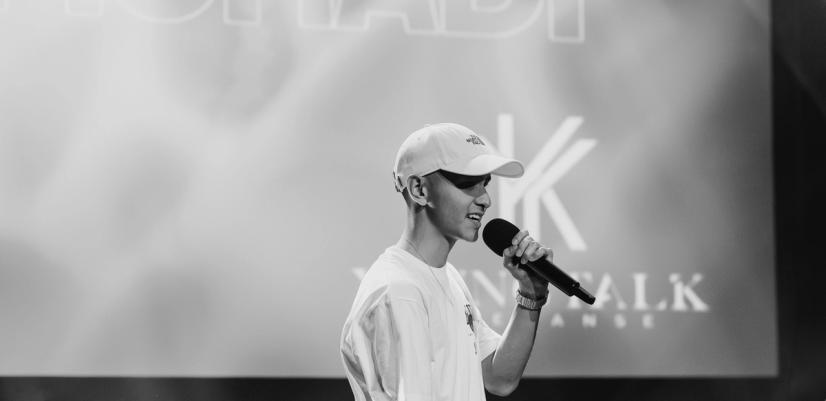
Rap lets Hamid say things he otherwise finds hard to talk about.
Inger Paulsen
Words on the wall
Hamid is 12 years old when his father comes home from work one evening and tells his older brother to pack his things.
‘“You’re leaving tonight,” he said. Then he looks at me and asks if I want to go too. I look at my mum. She laughs, because she thinks dad is joking. Then she realises he means it.’
Hamid packs his things too.
The journey takes them first to Istanbul, then to Greece, where the brothers are thrown into prison. With other refugees and criminals, they share a small, cold cell with no light and no windows. Hamid sits on the hard stone floor in two pairs of trousers, wrapped in a blanket bearing the UN logo.
‘It was bitterly cold.’
The police come in regularly with food. In the beam of their torches, Hamid spots something on the walls.
Words.
Poems in different languages, written by people who sat there before him. Small stories about life on the move, far away from family.
Hamid starts writing too.
What begins as poetry later turns into rap. First in Dari and Persian, then in Norwegian. But the new language makes him unsure of himself.
‘As you can hear, I speak with an accent, and I thought: why would anyone listen to what I have to say if I can’t even get the words right?’
He keeps going. Inspired by Norwegian rappers such as Lars Vaular, Vinni and Kamelen, as well as Persian rap, he gradually finds his own sound: a mix of Bergen dialect, Kebabnorsk street slang, Persian and Arabic.
He writes about what he knows. Integration, social problems and his own family’s story.
In the track ‘Hva vet du’ (‘What do you know’), he raps:
‘Do you know what it means to live among the Taliban.
My parents had to leave Afghanistan.
Then they fled to Iran.
Just to be able to live.’
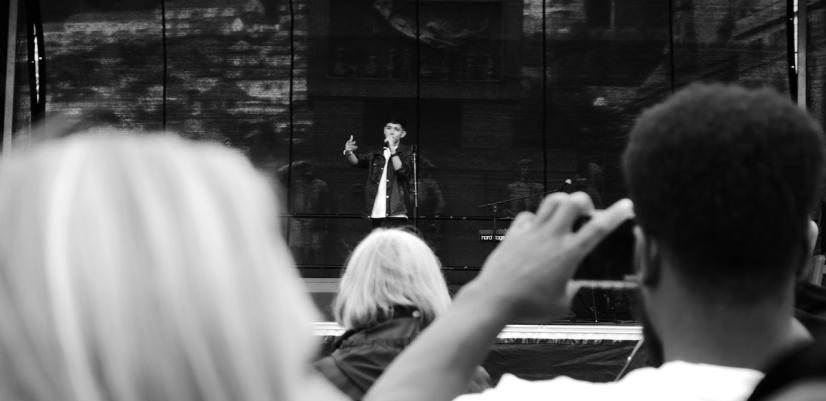
His first gig gave him the confidence to continue
Baltzer
Daring to be heard
The first time Hamid performs in front of an audience, he is so nervous he can’t look at them.
His legs are shaking. He keeps his eyes down. Phone in one hand, microphone in the other, he paces back and forth across the stage, reading his lyrics.
Then the crowd starts hyping him up.
‘I was so happy. It was the coolest thing I’d ever done.’
Afterwards, people come up to him.
Nice. You were good.
‘That’s when I thought: maybe I should do this more often?’
Hamid starts posting videos on TikTok. One of them gets 90,000 views.
It could have been his breakthrough.
Instead, the comments section fills up with hateful, racist abuse.
Hamid wants to delete the video. Maybe his whole account.
Then he talks to Petter De Presno at the youth organisation Springbrett for ungdom.
‘He told me not to. Then they win.’
The support from Petter, Hanne, Cidi and the others at Springbrett keeps him going.
‘I managed to see the comments from a different perspective.’
With hip-hop, I’m stronger
For Hamid, music runs deeper than performing. Rap lets him say things he otherwise finds hard to talk about.
‘I don’t dare talk to people, but if it’s through rap, I won’t hesitate. Then I’ll say everything.’
He describes hip-hop as a force.
‘Hip-hop gave me the ability to express myself and talk to people. I’ve always believed hip-hop is a power that carries me through tough, difficult days.’
Music gave Hamid a voice.
The people gave him a place to belong.
When he was in Germany and had to go to hospital, Hanne and Cidi messaged him in the middle of the night to ask how he was doing. When he needed help buying a plane ticket at 2.30 in the morning, he knew exactly who to call.
For Hamid, Springbrett has become much more than a place to make music.
‘If I wasn’t part of Springbrett, I wouldn’t be the person I am today.’
Before moving to Bergen, Hamid lived in Hønefoss, a short trip from Oslo.
‘Back then, I looked up to the guys who hung around Oslo Central Station.’
Today, he names different people.
‘Since getting to know Springbrett, I look up to Hanne, Petter and Cidi.’
Learn more about Springbrett for ungdom
Related news and articles
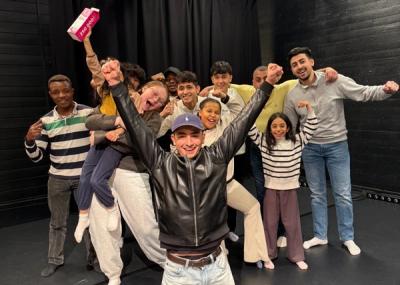
Together Through Growth: Funding for an Inclusion Project for Young People
Springbrett for ungdom has received support from the Kavli Trust for free leisure activities that provide young people with safe meeting places, new opportunities and a stronger sense of belonging. The project aims to prevent social exclusion and strengthen young people’s mental health.

Hip hop made med stronger
About Hamid Reza
Hamid is a rapper, songwriter and member of the youth council at Springbrett for ungdom. He started writing poems at 11, while fleeing Iran, and has since developed his own sound, drawing on several languages and cultures. Today he uses his experiences and his voice to lift up other young people. This autumn, he will lead a songwriting course in hip-hop.